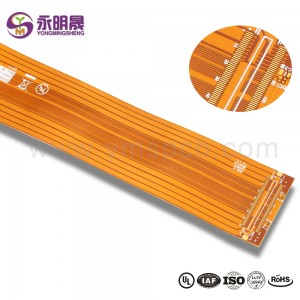
Bendable, 2 layer flexible printed circuit board
Parameters
Layers 2
Base MaterialPolyimide , 2OZ ,0.20 MM finished
Minimum Line Range/ Concurrence :0.15 mm/0.25 mm
Size : 480 mm × 45 mm
Face treatment : LEAD FREE HASL
Crafts
Special Process : Hard Bobby
Operations
Medical Instrument
Critical model after 24-48 hours/ generally after 2-3 days dispatching
https://www.ymspcb.com/2layer-flexible-printed-circuit-board-ymspcb-3.html
Flexible Material Slicing
Most flexible board accoutrements arerollingformat.For different demanding , makers need to optimizetheutilization.The first step in making FPC is slicing flexible material toworkingsize.Roll-to-roll manufacturing is used to some mass- produced FPC and also the slicing procedure can be barred.
What is a flex PCB stiffener?
The purpose of the stiffener is to strengthen the mechanical strength of FPC ( flexible circuit board) on account of easing the underpinning of factors on the PCB face,etc.The types of stiffener used in the flexible circuit board are various, which mainly depends on the conditions of the product, analogous as PET, PI, cement, substance or resin stiffener,etc.
Flexible PCBs (FPC) are the PCBs that can be fraudulent or crooked without damaging the circuits, which means the boards can be fraudulent freely to conform to the asked shape during operations. The material the substrate used is flexible, analogous as Polyamide, PEEK, or a conductive polyester film. In multitudinous cases, flex circuits are made of polyimide or a similar polymer. This material dissipates heat better than utmost rigid circuit board paraphernalia. For this reason, flexible circuits can be placed in inconvenient locales where heat would impact the performance of a rigid circuit board. Flexible circuit boards can be designed to repel extreme temperatures – between-200 ° C and 400 ° C – which explains why they are so desirable for borehole measures in the oil and gas sedulity.
In fact, because of these conditions, and the need for small, unnoticeable bias in utmost artificial surroundings, flexible circuits represent the first choice for engineering design in utmost artificial sensor technologies.
High-temperature resistance comes generally comes with good chemical resistance and excellent resistance to radiation and UV exposure as well. Combined with the capability to control impedances in high- density circuit board designs, flexible circuit designs offer multitudinous benefits to manufacturers.
To learn more, please click here:
YONGMINGSHENG TECHNOLOGY CO., LTD.

评论
发表评论